Cambium ePMP 5 GHz Discontinued Replacement Guide | Force EOL Dates
Cambium ePMP 5 GHz Replacement Guide: Official Timelines, Item-by-Item Comparisons and a Migration Plan for Force 180 / 190 / 200 and ePMP Base Stations
At a Glance
Who this is for: ISP and private-network engineers running Cambium ePMP 5 GHz sites who need to know which units have reached end of sale, which are past end of support, and how to sequence the replacement work.
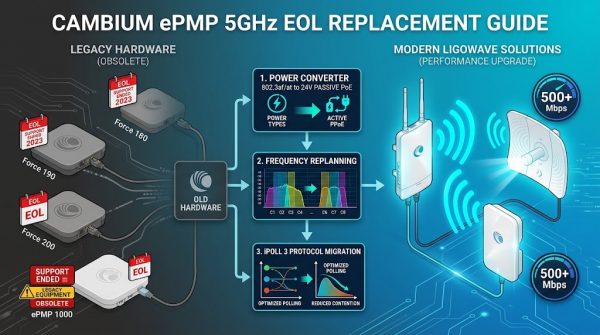
The short version: Cambium’s 5 GHz ePMP line has moved almost entirely into its retirement cycle — Force 190, Force 200 5 GHz and ePMP 1000 are past end of support; Force 180, Force 300-19 and Force 300 CSM have reached end of sale; and even the ePMP 3000 base station was withdrawn from sale in March 2026. Cambium applies a fixed “end of support four years after end of sale” rule, so replacement dates can be worked out precisely in advance.
What this guide covers: the full EOS/EOL list with official dates, the quoted official reasons for retirement, item-by-item Force vs LigoDLB spec comparisons (gain, beamwidth, transmit power, channels, power, power draw — all laid out), and the three problems that are specific to Cambium: how to replan frequencies when a GPS Sync base station becomes an iPoll 3 sector, how to convert 802.3af/at power to 24 V, and how to recalculate sector capacity. It closes with a six-phase migration process and a per-site checklist.
Where Things Stand: A Timeline You Can Work Backwards From
Cambium is the most formalized of the three vendors when it comes to retirement: its Product Lifecycle page publishes both End of Sale (EOS, the last order date) and End of Support (EOL, the support cutoff), and for fixed wireless products it applies a strict “end of support four years after end of sale” rule. That has one clear benefit — for any ePMP unit you own, knowing the official EOS date tells you exactly how much support life remains, so replacement scheduling needs no guesswork.
Across the 5 GHz line as a whole, risk falls into three tiers, from most to least urgent:
- Already past EOL: Force 190, Force 200 (5 GHz) and the entire ePMP 1000 line — no vendor technical support, no firmware updates (including security patches), no hardware repair. If one fails, your only options are salvaging spares or buying secondhand, which is a genuine availability risk for carrier-grade links.
- Past EOS, still within support: Force 180 (last order 2025-03-31), Force 300 CSM (2025-06-30) and Force 300-19 (2025-09-30) — the new-purchase channel is closed, so anything buyable now is channel stock. Support remains, but the clock is running down.
- Just past or approaching EOS: ePMP 3000 AP (withdrawn 2026-03-24), ePMP 3000L and MP 3000 — note this tier, because even the “upgrade to a newer Cambium base station” path is narrowing. If your migration plan was “replace ePMP 1000 with ePMP 3000,” that plan needs revisiting.
The conclusion is straightforward: for installed Cambium 5 GHz sites, restocking the same model is no longer viable, and upgrading within the brand is getting harder. Replacement options need evaluating now, not at the next hardware failure.
The Complete Official EOS / EOL List
| Product | Official EOS (end of sale) | Official EOL (end of support) | Status (as of 2026-09) | Key specs |
|---|---|---|---|---|
| ePMP Force 180 | 2025-03-31 | 2029-01-31 | End of sale, within support | 16 dBi / 15° azimuth · 30° elevation / gigabit port / ≤10 W (5 W typical) / TX −17 to +30 dBm / IP55 |
| ePMP Force 190 | 2021-11-03 | 2025-11-03 | End of support | 22 dBi / 200 Mbps / Fast Ethernet port / ≤8 W / TX −15 to +27 dBm |
| ePMP Force 200 5 GHz | 2021-09-30 | 2025-10-29 | End of support | 25 dBi dish / >200 Mbps / gigabit port / ≤10 W / TX −15 to +30 dBm |
| Force 200AR5-25 high-gain (ROW) | 2022-12-31 | 2026-12-31 | End of sale, within support | 25 dBi / 5 GHz high-gain |
| ePMP Force 300-19 | 2025-09-30 | 2029-09-30 | End of sale, within support | 19 dBi connectorized panel / 600 Mbps / 5–80 MHz |
| ePMP Force 300 CSM | 2025-06-30 | 2029-06-30 | End of sale, within support | Connectorized / 600 Mbps / 5–80 MHz / 12 W |
| ePMP Force 300-13L | 2024-04-30 | 2028-04-30 | End of sale | 13 dBi-class 5 GHz SM |
| ePMP Force 300-13 | 2022-12-31 | 2026-12-31 | End of sale, support nearly expired | 5 GHz SM |
| ePMP 1000 (GPS Sync / Connectorized / Integrated / Hotspot) | 2020-02-05 to 04-08 | 2025-02-05 to 07-08 | End of support | 5 GHz base station / CPE platform |
| ePMP 2000 (AP / AP Lite) | 2022-05-13 | 2026-09-30 | Support expiring | 5 GHz AP platform |
| ePMP MP 3000 MicroPOP | 2025-09-30 | 2029-09-30 | End of sale | 5 GHz micro-site |
| ePMP 3000 AP Radio | 2026-03-24 | 2030-03-25 | End of sale | 4×4 MU-MIMO base station / 90°·120° sector / 600 Mbps per sector / up to 120 subscribers |
| ePMP 3000L AP Radio | 2025-05-30 | 2029-05-30 | End of sale | 2×2 base station / 90° sector / up to 64 subscribers |
| PMP 430 (5.4 / 5.7 / 5.8 GHz) | 2015-05-12 | 2020-05-13 | Long past end of support | 5 GHz OFDM base station |
| PTP 450 (5 GHz) | 2017-11-08 | 2022-11-08 | Long past end of support | 5 GHz PtP |
| PTP 250 / PTP 230 (5 GHz) | 2015 | 2020 | Long past end of support | 5 GHz PtP |
Still in production, for reference: ePMP Force 300-16 (16 dBi panel / 600 Mbps / 12 W), Force 300-25 (25 dBi dish / 600 Mbps / 12 W), Force 425, Force 400C and the ePMP 4600 series — none of which appear on Cambium’s Discontinued list.
Official Retirement Reasons and Lifecycle Policy
What Cambium says about why products retire
Cambium does not explain reasons model by model. Two official policy pages give portfolio-level language instead:
In plain terms, three factors: market demand, technology innovation, and regulatory change. Cambium never cites component obsolescence as a model-level reason, so we do not either. What the wording does signal — usefully, for buyers — is that Cambium is concentrating resources on newer platforms, which is why every recommended replacement points to one (see section 4).
The official lifecycle policy: why EOL can be predicted
| Milestone | Official rule (fixed wireless products) |
|---|---|
| Lifecycle announcement | Issued six months before end of sale |
| End of Sale (EOS) | Last order date; Cambium commits to at least 180 days’ notice (90 days for enterprise products) |
| Software maintenance ends | 3 years after EOS |
| Cambium Care / extended warranty renewals end | 3 years after EOS |
| Management platform support ends | 4 years after EOS |
| End of Support (EOL) | 4 years after EOS; no further technical, software or hardware support |
Checking the rule against the table: Force 190’s EOS of 2021-11-03 gives an EOL of 2025-11-03, and Force 180’s EOS of 2025-03-31 gives 2029-01-31 — exactly four years in both cases. The practical value: for any Cambium device with a known EOS date, add four years to get its support endpoint; subtract the spares-procurement and migration lead time you need, and you have the date by which replacement must start. If you are still running ePMP 2000, for instance (EOL 2026-09-30 — this very month), starting the assessment now is not early.
Cambium’s Own Recommended Replacements (Same-Brand Path)
The official lifecycle table names a recommended replacement for every retired SKU. Cambium defines “Recommended Replacement” as follows (verbatim):
| Retired model | Cambium’s recommended replacement (same brand) | Key specs of the replacement |
|---|---|---|
| Force 180 / Force 190 | Force 300-16, Force 300-25L, Force 4518 | Force 300-16: 16 dBi panel / 600 Mbps / 12 W (15 W in extreme cold) |
| Force 200 5 GHz (including 200AR5-25) | Force 300-25, Force 425 | Force 300-25: 25 dBi dish / 600 Mbps / 12 W; Force 425: 25 dBi / 1 Gbps / 802.11ax / RJ45 + SFP |
| Force 300-19 | Force 300-16, Force 300-25, Force 425 | As above |
| Force 300 CSM | Force 300 CSML | Connectorized |
| ePMP 1000 (all versions) | ePMP 4500, Force 300-25, Force 425 | New-generation platform |
| ePMP 2000 (AP / AP Lite) | ePMP 4500 | New-generation platform |
Read that path carefully: every recommendation is a new-generation platform (the Force 425 is already 802.11ax with an SFP port), not a like-for-like swap. In practice, going the official route means a generational migration — more platform capability, and a correspondingly higher unit price — and moving from an ePMP 1000/2000 base station to an ePMP 4500 is a whole-site architecture upgrade. That path suits sites that already planned to expand and upgrade.
LigoWave occupies a different position: it offers a same-tier, low-disruption replacement — keeping the existing 5 GHz architecture, reusing the existing antenna system (connectorized sites) and converting power with a low-cost 24 V injector. The two paths are not mutually exclusive; it is common to see a mixed approach on one network, with core sites moving to Cambium’s new platform and edge sites taking the low-disruption LigoWave route. Every comparison below assumes that framing.
LigoWave Substitution Master Table
| Retired Cambium model | Recommended LigoWave model | Substitution level | Rationale |
|---|---|---|---|
| Force 300 CSM (connectorized / 600 Mbps) | LigoDLB 5ac | ✅ Full substitution | Both connectorized, 802.11ac, gigabit; the existing external antenna and feeder can be reused — the cleanest one-to-one swap in the table |
| Force 190 (22 dBi / past EOL) | LigoDLB 5-20ac | ✅ Full substitution (upgrade) | 2 dB gain difference; 200 Mbps / Fast Ethernet → 500+ Mbps / gigabit, a pure upgrade |
| Force 300-13L (13 dBi class) | LigoDLB 5-15ac | ✅ Full substitution (upgrade) | 2 dB more gain, plus throughput and interface upgrades |
| Force 180 (16 dBi / 15° Az · 30° El) | LigoDLB 5-15ac | ⚠️ Partial substitution | 1 dB gain difference and same interface class, but the beam shape differs significantly (see 6.2), so coverage must be replanned |
| Force 300-19 (19 dBi connectorized panel) | LigoDLB 5ac + 19–20 dBi directional antenna or 5-20ac | ⚠️ Partial substitution | Gain can be matched; the connectorized option stays closest to the original install, while the all-in-one is more integrated |
| Force 200 5 GHz (25 dBi dish / past EOL) | LigoDLB 5-20ac (≤8 km) 5ac + 25 dBi dish (>8 km) |
⚠️ Partial substitution | 5 dB gain difference; direct swap at short to mid range, external dish at long range, per section 8 |
| ePMP 1000 / 2000 AP | LigoDLB 5-90AC | ⚠️ Architectural substitution | GPS Sync base station → iPoll 3 sector site; the frequency plan and sector capacity must be recalculated (see section 7 and phase 2 of the migration plan) |
| MP 3000 MicroPOP | LigoDLB 5-90AC | ⚠️ Partial substitution | Same micro-site form factor; replan by actual sector angle and capacity |
| PMP 430 / PTP 450 / PTP 250 (EOL for years) | 5-90AC + 5-20ac (PtMP) 2 × 5-20ac (PtP) |
✅ Full substitution (generational) | Past end of support for over five years; a full generational change is required, so plan directly around the LigoWave architecture |
How to read the verdicts: full substitution = form factor matches, gain difference ≤2 dB, same interface class, and a clear power method, with no need to re-survey the site (power conversion is costed separately). Partial substitution = one factor needs recalculating (3–5 dB gain difference or a changed beam shape), so the link budget must be rechecked before the swap.
Spec Comparison, Item by Item
6.1 Force 300 CSM vs LigoDLB 5ac — the head-to-head for connectorized sites
| Item | Cambium Force 300 CSM (EOS 2025-06-30) | LigoWave LigoDLB 5ac |
|---|---|---|
| Form factor | Connectorized (external antenna) | Connectorized (2×N-type external) |
| Band / standard | 5 GHz / 802.11a/n/ac | 5 GHz / 802.11a/n/ac |
| Channel width | 5/10/20/40/80 MHz | 5/10/20/40/80 MHz (identical) |
| Throughput | 600 Mbps | 500+ Mbps |
| Ethernet | Gigabit class | 1× 10/100/1000 |
| Transmit power | Not listed separately (Cambium’s 5 GHz line commonly −15 to +30 dBm) | ≤30 dBm; 24–29 dBm at 80 MHz |
| Receiver sensitivity | Not listed separately | −90 to −64 dBm (80 MHz) |
| Power draw | 12 W | 10 W |
| Dimensions / weight | Not listed separately | 150 × 115 × 55 mm / 450 g |
| Power | 802.3af/at | 24 V passive PoE |
| Wireless protocol | ePTP (Cambium proprietary) | iPoll 3 (proprietary) |
| Management | cnMaestro | WNMS |
What this table means in practice: the RF and interface side matches throughout — identical channel widths step for step, gigabit on both, sensitivity in the same class. The only hard difference is the power convention, which is also the only thing that needs physical work on a Cambium replacement. The more valuable point lies elsewhere: your investment in external antennas and feeder cable is preserved in full. On connectorized sites the antenna system (antenna, feeder, tower work) often accounts for more than half the site cost; moving CSM to CSML is a same-brand connectorized swap, and the 5ac route is likewise “change the radio only, leave the antenna system alone.” Two things to check during the swap: whether the N-type connector weatherproofing needs redoing (mandatory on any disconnect/reconnect) and whether the feeder VSWR is still within spec.
6.2 Force 180 vs LigoDLB 5-15ac — why the beam shape matters more than the gain figure
| Item | Cambium Force 180 (EOS 2025-03-31) | LigoWave LigoDLB 5-15ac |
|---|---|---|
| Antenna gain | 16 dBi | 15 dBi |
| Beam shape (3 dB) | 15° azimuth / 30° elevation (flattened cone) | 35° / 35° (symmetric cone) |
| Band / standard | 5 GHz / 802.11a/n/ac | 5 GHz / 802.11a/n/ac |
| Channel width | 5/10/20/40 MHz | 5/10/20/40/80 MHz |
| Throughput | ePMP platform class | 500+ Mbps |
| Transmit power | −17 to +30 dBm | 24–29 dBm at 80 MHz, ≤30 dBm |
| Ethernet | 10/100/1000 | 10/100/1000 |
| Power draw | ≤10 W (5 W typical) | 10 W |
| Ingress protection | IP55 | IP-65 |
| Power | 802.3af/at | 24 V passive PoE |
| Official coverage guidance | Not given | PtMP 5 km / PtP 7 km |
Why this pair is a “partial substitution”: gain differs by only 1 dB and the interface is the same class, so the issue is the beam shape — the Force 180 is a flattened cone at 15° azimuth and 30° elevation (narrow on the horizontal plane), while the LigoDLB 5-15ac is a symmetric 35° cone. That affects coverage geometry, not the link budget. If the original site relied on a 15° horizontal beam for “point-to-point-style coverage with neighbouring-cell interference suppressed,” moving to a 35° cone will increase sidelobe leakage into adjacent sectors. What to do: for short-range standalone coverage sites, swap directly — no impact. For sites with multiple sectors on one tower or tight frequency reuse, retest adjacent-cell interference after the swap and reduce transmit power or adjust channels if needed. This is one reason the guide repeatedly stresses rechecking power against the local EIRP limit after replacement.
6.3 Force 190 / Force 200 vs LigoDLB 5-20ac — replacing the two models past end of support
| Item | Force 190 (EOL 2025-11-03) | Force 200 5 GHz (EOL 2025-10-29) | LigoWave LigoDLB 5-20ac |
|---|---|---|---|
| Antenna type | Integrated directional | Integrated dish | Integrated dual-polarized directional panel |
| Antenna gain | 22 dBi | 25 dBi | 20 dBi |
| Beamwidth (3 dB) | Not listed officially | Not listed officially (highly directional dish) | 16° / 16° |
| Throughput | 200 Mbps | >200 Mbps | 500+ Mbps |
| Ethernet | 10/100 (Fast Ethernet) | Gigabit | 10/100/1000 |
| Channel width | 5/10/20/40 MHz | 5/10/20/40 MHz | 5/10/20/40/80 MHz |
| Transmit power | −15 to +27 dBm | −15 to +30 dBm | 24–29 dBm at 80 MHz |
| Power draw | ≤8 W | ≤10 W | 10 W |
| Ingress protection | Not listed officially | Not listed officially | IP-65 |
| Official coverage guidance | Not given | Not given | PtMP 10 km / PtP 15 km |
| Support status | End of support | End of support | In production, actively maintained |
Replacing the Force 190 is the easiest job in the table: a 2 dB gain difference is barely perceptible in the link budget, and 200 Mbps with a Fast Ethernet port becoming 500+ Mbps with gigabit is a pure upgrade — and since the unit is already out of support, there is no reason to wait. The Force 200’s 25 dBi dish splits into two cases by distance (≤8 km a direct swap to the 5-20ac; >8 km a 5ac with a dish, per section 8). Both share one point worth noting: Cambium never published coverage guidance, whereas the LigoDLB 5-20ac datasheet spells out PtMP 10 km / PtP 15 km — a design figure you can quote directly in a proposal.
6.4 ePMP 1000 / 2000 base stations vs LigoDLB 5-90AC — an architectural replacement on the base-station side
| Item | Cambium ePMP 1000 / 2000 | Cambium ePMP 3000 (reference) | LigoWave LigoDLB 5-90AC |
|---|---|---|---|
| Role | 5 GHz sector / base-station AP | 4×4 MU-MIMO base station | 5 GHz integrated 90° sector station |
| Antenna gain | Depends on the 90°/120° sector configuration | 90°/120° sector | 18 dBi (integrated) |
| Azimuth / elevation beam | 90° or 120° sector | 90° / 120° | 90°, 20° elevation |
| Air interface | 802.11n platform | 600 Mbps per sector / up to 120 subscribers | 802.11ac / 500+ Mbps |
| Subscriber capacity | Platform class | 120 subscribers (3000) / 64 subscribers (3000L) | No official ceiling published; must be measured in a pilot |
| Ethernet | Fast Ethernet / gigabit | 100/1000 | Gigabit |
| Power | — | 802.3af/at | 24 V passive PoE |
| Synchronization | GPS Sync (co-channel sector reuse) | GPS Sync | No GPS sync (conventional frequency planning) |
| Enclosure / protection | Plastic enclosure, IP55 class | — | IP-65 |
| Protocol / management | ePMP / cnMaestro | ePMP / cnMaestro | iPoll 3 / WNMS |
A base-station replacement must be treated as an architectural change, not a CPE swap. Two reasons. First, the ePMP 1000/2000 runs on an 802.11n platform while iPoll 3 is ac plus TDMA, so the air interface behaves differently. Second, and more importantly, GPS Sync and iPoll 3 represent two different networking philosophies. GPS Sync lets multiple sectors on one tower operate co-channel (using time synchronization to cancel mutual interference); once you move to an architecture without GPS sync, frequency planning returns to the conventional approach — staggering channels between adjacent sectors and using horizontal/vertical polarization isolation. The original frequency plan cannot be carried over and must be rebuilt (see phase 2 of the migration plan). On subscriber capacity, be straightforward: ePMP 3000 is officially rated at 120 subscribers, while LigoDLB 5-90AC has no published per-site ceiling — that number must come from a pilot, so do not trust any back-of-the-envelope “equivalent capacity” figure.
Six Decision Dimensions Beyond the Datasheet
Dimension 1: Network architecture — GPS Sync and frequency planning
This is the dimension that matters most in any Cambium replacement, ahead of any spec sheet figure. If an ePMP site used GPS Sync for co-channel sector reuse, then once it moves to an iPoll 3 sector architecture the old “one frequency for the whole tower” approach no longer holds and channels must be rearranged (staggered within the available spectrum plus polarization isolation). Treat “frequency replanning and network-wide coordination” as a separate work package. Conversely, if your site never used GPS Sync and its sectors already had staggered channels, this dimension is close to zero work.
Dimension 2: Power conversion — the mandatory change specific to Cambium
| Existing power method | Required change | Notes |
|---|---|---|
| Cambium-supplied 802.3af/at injector | Swap in the LigoDLB-supplied 24 V passive injector; cabling stays | De-energize and recover the old 802.3af injector |
| Central PoE switch | Disable PoE output on the switch port, then insert a 24 V passive injector | 802.3af’s 48 V cannot connect directly to LigoDLB (24 V passive convention; mismatched voltage risks damage) |
Suggested sequence: power down, swap the injector, confirm 24 V at the far end, then install the new unit. On sites with very long cable runs (80–100 m), check conductor gauge and voltage drop at the same time. This is a low-cost change, but it is the biggest difference between a Cambium replacement and a Ubiquiti or MikroTik one — the latter two are usually zero-touch on 24 V sites, whereas Cambium always requires it.
Dimension 3: Management and bulk operations
cnMaestro is a mature cloud management platform with broad functionality; WNMS provides bulk configuration, firmware upgrades and centralized monitoring. They are peers, so this dimension is not a reason to switch or stay — we do not count it as an advantage. What genuinely needs evaluating is management during the transition: with Cambium on cnMaestro and LigoWave on WNMS in the mixed period, the shorter the overlap between the two platforms, the better — which directly shapes how batches are divided (see phase 5).
Dimension 4: Lifecycle and supply certainty
Cambium’s lifecycle process is the most transparent of the three: dates are published and the rules are fixed, which deserves credit. But transparency also means the risk is quantifiable — ePMP 2000 support ends 2026-09-30, and Force 190 / 200 / ePMP 1000 have already crossed the line. After EOL a unit still runs, but there are no firmware updates (including security patches), no official repair and no Cambium Care renewal. Sort every device in your register into three tiers — past EOL, within support, approaching EOS — and replacement priority falls out on its own.
Dimension 5: Evolution path (6 GHz and new platforms)
Credit where it is due: on 6 GHz, Cambium is the best prepared of the three — ePMP 4600 / 4600L AP (5725–7125 MHz, MU-MIMO/OFDMA, up to 120 subscribers, SFP+, 802.3at) plus Force 4600C / Force 4625 SM form a complete 6 GHz line. The LigoDLB 6 series (5.9–6.4 GHz, built on the same platform as the 5ac) also offers a 6 GHz option, but it trails Cambium in platform generation (ac versus ax) and interfaces (no SFP+). If your network operates where 6 GHz is already authorized and you have a clear next-generation upgrade plan, the Cambium 4600 route is the more appropriate choice; if the goal is “keep the existing 5 GHz network running cheaply while retaining a smooth 6 GHz option,” LigoWave’s value is a lower evolution cost thanks to a shared platform and protocol. One regulatory caveat: 6 GHz policy varies widely by country (in mainland China, 5925–7125 MHz is not opened for civilian use), so confirm local rules before planning around it.
Dimension 6: Procurement and cost structure
The two paths differ in how the cost breaks down. The official path (Force 300-16/300-25/425, ePMP 4500) buys new-generation platform capability in exchange for a generational unit cost and possibly a whole-site architecture upgrade. The LigoWave route is a same-tier ac platform plus antenna reuse (on CSM sites) plus a small 24 V injector change, with less site work and spares shared across the 5ac and 6 series. When comparing budgets, list three items separately: unit price, per-site conversion cost (injector plus labour), and five-year cost of ownership (including a probability-weighted allowance for a future whole-site replacement). That third item is the one most often left out, and it is usually the largest in any end-of-life decision.
How to Calculate the Link Budget (Do This First)
Wherever the replacement involves a gain difference — the Force 200 (25 dBi → 20 dBi) or the Force 300-19 (19 dBi) — run the numbers before touching anything. Four steps, all built on official figures.
Step 1: FSPL (free-space path loss)
At 5.8 GHz: 5 km ≈ 121.7 dB; 8 km ≈ 125.8 dB; 10 km ≈ 127.7 dB; 15 km ≈ 131.2 dB.
Step 2: RSL (received signal level) worked examples
Example 1 (Force 190 → 5-20ac, 8 km link): taking the mid-range 80 MHz transmit power of 25 dBm and 1 dB of cable and connector loss:
RSL = 25 + 20 + 20 − 125.8 − 1 = −61.8 dBm. Against the 5-20ac’s 80 MHz sensitivity range (−90 to −64 dBm), the top rate tier (around −64 dBm) is usable with margin to spare. The original Force 190 (22 dBi, +27 dBm ceiling) works out at roughly −57.8 dBm on the same link — about 4 dB better, mostly from the 2 dB gain and the higher power ceiling. Conclusion: within 8 km, swap directly.
Example 2 (Force 200 → 5-20ac, 10 km link): RSL = 25 + 20 + 20 − 127.7 − 1 = −63.7 dBm, right at the edge of the top rate tier with no fade margin. The original Force 200 (25 dBi, +30 dBm ceiling) was around −56.7 dBm with margin to spare. Conclusion: at the 10 km tier, the 5-20ac needs de-rating (a 40 MHz channel improves sensitivity by about 3 dB, or drop one modulation step), or move to a LigoDLB 5ac with a 25 dBi dish to preserve the original margin — which is exactly why the substitution table draws the line at 8 km.
Step 3: Choose a tier from the gain difference
| Gain difference | Verdict | Action |
|---|---|---|
| ≤2 dB (Force 190 → 5-20ac, 300-13L → 5-15ac) | Direct swap | No budget recalculation needed |
| 3–5 dB and link ≤8 km (Force 200 → 5-20ac) | Swap viable | Recheck the RSL with the formula and confirm ≥10 dB margin |
| ≥5 dB and link >8 km, or wet climate | Change approach | LigoDLB 5ac + a dish of 25 dBi or more (reuse the original dish if it is in good condition) |
Step 4: Three things easily missed
- Fresnel zone: on a 5.8 GHz / 8 km link the first Fresnel zone radius at the midpoint is about 10 m; confirm at least 60% clearance — obstruction loss is far more damaging than a 5 dB gain difference.
- Rain fade: allow 5–10 dB for long links in wet regions.
- EIRP compliance: after replacement the gain and power combination at each end changes, so recheck against the local 5 GHz EIRP limit and dial the transmit power down accordingly. This is not only a compliance matter but also a way to avoid interfering with neighbouring cells — especially after moving to a wider 35° CPE beam.
Deployment Scenarios and Configurations
| Scenario | Typical configuration | Why this choice |
|---|---|---|
| Force 190 / 200 installed CPE at end of life | Point-by-point swap to LigoDLB 5-20ac | Gain and interface match, throughput improves; the units are out of support, so there is no reason to wait |
| Force 300 CSM connectorized site (external antenna already installed) | LigoDLB 5ac, reusing the existing antenna and feeder | The only replacement path that leaves the antenna system untouched, changing the radio only; redo weatherproofing when reconnecting the N connector |
| ePMP 1000 / 2000 base stations retired, 5 GHz access network rebuilt | LigoDLB 5-90AC + LigoDLB 5-15ac | Rebuild as “sectors plus uniform CPE”; iPoll 3 time-slot scheduling raises per-site CPE capacity; frequency and sector capacity need replanning |
| Harsh high-humidity or dusty environments | LigoDLB 5-90AC (IP-65) | Higher than the Force 180’s IP55; pair with proper grounding and lightning protection |
| Heavily congested 5 GHz areas (declining experience on the original site) | 5-90AC + 5-20ac | 80 MHz channels plus iPoll 3 time-slot scheduling hold throughput more steadily under congestion; 5/10 MHz narrow channels are the last resort for squeezing the spectrum |
| Video surveillance / private-network backhaul | 5-20ac (PtP) + 5-90AC (aggregation) | QoS (L2 CoS / L3 ToS-DSCP, WRR) plus gigabit ports support concurrent video streams reliably |
| Introducing a second supplier to spread single-brand lifecycle risk | Move part or all of the network to the LigoDLB 5ac family | Official replacements all point to the same brand’s new platform; running multiple brands reduces single-point retirement risk |
Strengths and Limitations
Five genuine strengths
- A “same-tier, low-disruption” replacement option: the official path is a generational migration, whereas LigoWave offers a one-to-one swap on a same-tier ac platform — no re-survey (all-in-one) and no interference with the antenna system (connectorized). It suits installed sites that just need to keep running healthily.
- A complete connectorized product line: once the Force 300 CSM retires, Cambium’s connectorized options narrow; the LigoDLB 5ac keeps a 2×N connectorized model, and reusing the antenna system saves the largest single slice of site cost.
- A pure upgrade for end-of-life models, in interface and speed: Force 190 (200 Mbps / Fast Ethernet) → 5-20ac (500+ Mbps / gigabit), 2.5× the throughput.
- Better protection on sector base stations: the LigoDLB 5-90AC is IP-65, higher than the Force 180’s IP55.
- Definite link design figures: the official datasheet gives PtMP / PtP coverage guidance that can be cited directly in a bid, reducing disputes over calculations.
Three limitations we will state plainly
① On the base-station side it is an architectural replacement, not a device swap. Sites using GPS Sync for co-channel sector reuse must have their frequency plan rebuilt after moving to iPoll 3, and the per-site CPE capacity has no published figure — only a pilot can establish it. Schedule both as separate work packages.
② Power conversion is mandatory. Every site on 802.3af/at needs a 24 V passive injector (low cost, but not optional), and the 48 V from an 802.3af switch cannot connect directly to LigoDLB.
③ No all-in-one dish above 25 dBi, and 6 GHz sits a generation below Cambium’s newest platform. Long-range Force 200 links go to a 5ac with an external dish; for sites with a definite next-generation upgrade plan, the Cambium 4600 series is the stronger choice on 6 GHz and platform generation — in that case we recommend planning along the Cambium path, with LigoWave covering the “low-disruption keep-running” portion of the estate.
Migration Plan (Six Phases)
The biggest difference between a Cambium replacement and the other two brands: some devices are already past end of support (which gives a natural priority split), and there is a base-station architectural replacement (which adds two work packages — frequency replanning and capacity recalculation). The process below is designed around that.
Export every ePMP 5 GHz site from cnMaestro or your local register, with at least these fields per record:
| Field | Description / how to collect |
|---|---|
| Model + EOS/EOL dates | Annotate against the list in section 2, in three tiers: past EOL / within support / approaching EOS |
| Device role | AP (with sector angle) / SM / PtP |
| GPS Sync status | Whether the site uses synchronization and co-channel sector reuse (cnMaestro / device configuration) |
| Frequency / bandwidth / signal / throughput baseline | Measure three times off-peak and average |
| Link distance / azimuth | GPS coordinate difference / compass |
| Power method | 802.3af/at injector / PoE switch / cable length |
| Subscriber count per sector (base-station side) | Current SMs per sector — the input for the capacity recalculation in phase 2 |
| Committed bandwidth per subscriber | Plan or SLA terms |
| Traffic class | A / B / C |
Exit criteria: the list is sorted into the three tiers, with “past EOL” and “GPS Sync co-channel sites” flagged separately — the former sets priority, the latter sets workload.
This phase carries two work packages more than the other two brands:
Exit criteria: every site has a replacement model, an antenna plan, a power verdict, a frequency plan (if it involves a base station) and a capacity verdict.
Exit criteria: every unit passes a power-on self-test, and configurations map one-to-one to the frequency plan.
Selection criteria: one end-of-life link (Force 190 → 5-20ac, to validate the substitution verdict) plus one multi-sector base station (ePMP 1000/2000 → 5-90AC, to validate both the frequency replanning and capacity work packages). Work in a low-traffic window:
- Record the baseline: take another round of signal, CCQ, throughput and latency readings from the old link.
- Photograph and label: record azimuth, elevation, wiring order, sector orientation and polarization.
- Convert power first: power down → swap in the 24 V injector → confirm voltage at the far end → then install the device. Always de-energize and recover the original 802.3af circuit.
- Swap base stations one sector at a time: on a multi-sector site, change one sector first and run it for a week, confirming adjacent-channel coexistence with unreplaced Cambium sectors is clean, before changing the rest.
- Validation checklist: successful registration (iPoll 3, not a fallback mode); RSL within 3 dB of the budget; throughput ≥ baseline; latency and packet loss no worse; VLAN / QoS / traffic normal; online in WNMS; and an adjacent-cell interference retest (against the spectrum occupancy recorded before the swap).
Rollback plan: seal the old device and a configuration backup; if validation falls short within the window and the cause is not identified within 30 minutes, reinstall the old device and reschedule the review. Base-station rollback in particular must be rehearsed in advance — the frequency-plan rollback steps belong in the runbook.
Exit criteria: the pilot link stable for 72 hours and the pilot base station’s single sector stable for a week, with the full validation checklist passed; a standard switching runbook and measured subscriber-capacity data documented.
Exit criteria: all target sites switched and stable for two weeks, with no unresolved rollbacks; the cnMaestro asset list cleared (or holding only devices kept by design).
Per-site switching checklist
| # | Check item | Pass criteria |
|---|---|---|
| 1 | Power conversion complete | 24 V passive injector in place; the original 802.3af circuit de-energized and recovered |
| 2 | Mounting orientation | Azimuth / elevation / polarization match the records (sector sites per the new frequency plan) |
| 3 | Weatherproofing and grounding | N-connector weatherproofing redone (mandatory on connectorized sites); grounding sound |
| 4 | Wireless registration | iPoll 3 registered correctly (not a fallback to standard 802.11) |
| 5 | Signal level | RSL within 3 dB of the budget, with ≥10 dB margin |
| 6 | Throughput / latency | ≥ the old link’s baseline; no degradation |
| 7 | Frequency coexistence | Neighbouring sites (including unreplaced Cambium sectors) show no worse interference |
| 8 | Service validation | VLAN, QoS and live traffic all normal |
| 9 | Management onboarding | Visible in WNMS, IP address consistent |
| 10 | Regulatory compliance | Transmit power / EIRP set to local limits |
References
- Cambium Networks, Product End-of-Life Policy: cambiumnetworks.com/eol
- Cambium Networks, Product Lifecycle (including the Discontinued list): cambiumnetworks.com/support/product-lifecycle
- Official data sheets for the ePMP Force 300 Series and ePMP 3000 Series; product pages for the Force 180 / 190 / 200
- LigoWave official data sheets (LigoDLB 5ac / 5-15ac / 5-20ac / 5-90ac): download.ligowave.org
All EOS / EOL dates, official quotations and specifications were verified on 2026-09-14. Vendor policies can change, so re-check the latest Cambium pages before a formal publication or tender submission.
Frequently Asked Questions
Q: Can the equipment still be used after the EOL date?
It will keep running, but support drops to zero. Under the official policy wording, after EOL Cambium no longer provides “technical, software and hardware support services” — no firmware updates (including security patches), no official repair, and no Cambium Care renewal. The hardware does not stop working, but for a carrier-grade link, having no spares guarantee when something fails and no patches for vulnerabilities is reason enough to schedule replacement. The priority order is simple: devices already past EOL (Force 190 / Force 200 5 GHz / ePMP 1000) go first, and everything still supported is scheduled backwards from its EOS date.
Q: Why do so many models reach EOL exactly four years after EOS?
Because that is the official lifecycle policy for fixed wireless products: “support ends four years after EOS” — software maintenance and extended-warranty renewals stop three years after EOS, and management platform support, along with support as a whole, ends at four years. Force 190 (EOS 2021-11-03 → EOL 2025-11-03) and Force 180 (EOS 2025-03-31 → EOL 2029-01-31) both follow the rule directly. The practical takeaway: for any device with a known EOS date, add four years to get the support endpoint; subtract your spares-procurement and migration lead time, and you have the date by which replacement must begin.
Q: The original Cambium site runs on 802.3af/at power — what exactly needs changing for a LigoDLB?
Swap the injector for a 24 V passive unit at each site; the cabling stays. Steps: power down → remove the original 802.3af power circuit → install the 24 V injector → confirm the voltage at the far end → then install the new device. Two cautions: the 48 V from an 802.3af switch cannot connect directly to a LigoDLB (24 V passive convention — mismatched voltage risks damage), so disable PoE output on the switch port; and on sites with 80–100 m cable runs, check voltage drop at the same time. This is a mandatory change for any Cambium replacement and belongs in both the materials and labour budget.
Q: Why is replacing an ePMP 1000 / 2000 base station with a LigoDLB 5-90AC described as an “architectural replacement”?
Two reasons. First, the ePMP 1000/2000 is a GPS Sync base-station architecture — sectors on one tower reuse the same frequency through time synchronization; the LigoDLB 5-90AC is an iPoll 3 sector architecture with no GPS sync, so frequency planning returns to the conventional approach of staggering channels between adjacent sectors plus polarization isolation. The original frequency plan cannot simply be copied. Second, the per-site CPE capacity is not published by the vendor, so it must be established by starting a pilot at 50–70% of the original sector’s subscriber count and measuring the result — it cannot be assumed to match ePMP. Base-station replacement therefore needs two separate work packages: frequency replanning and capacity recalculation.
Q: Cambium already lists recommended replacements — why look at LigoWave as well?
Cambium’s Recommended Replacement points to its own next-generation platforms (Force 300-16/300-25/425, ePMP 4500), which is essentially a generational migration — more platform capability, and correspondingly higher unit cost and site work. LigoWave serves a different need: a same-tier, low-disruption life extension — full antenna reuse on CSM sites, no re-survey on all-in-one sites, and a small 24 V injector change. The two paths are not mutually exclusive, and on one network it is common to run “Cambium’s new platform at core sites, LigoWave’s low-disruption swap at the rest.” If a site has a definite 6 GHz upgrade plan, the Cambium 4600 series is the more suitable choice — we say so plainly.
Q: How do I replace a Force 200 with its 25 dBi dish link?
Split by distance into two cases: at 8 km or less, swap directly to the LigoDLB 5-20ac (20 dBi — the 5 dB gain difference sits within the margin); above 8 km, or in wet regions, use a LigoDLB 5ac with a dish of 25 dBi or more, and reuse the original dish if it is in good condition. Calculate the RSL using the method in this guide before you start: on a 10 km link, the received level at each end with a 5-20ac is about −63.7 dBm, right at the sensitivity edge of the top 80 MHz rate tier with no fade margin. At that distance, either reduce the channel to 40 MHz (about 3 dB better sensitivity) or fit an external dish.